We Have a Problem with Meetings. It’s Called Meetingitis.
A meeting at 9:00.
Another at 10:00.
Another at 11:00.
At 12:00, you have a meeting to prepare for tomorrow’s meeting.
And when the last one ends, you realise you haven’t had time to do your actual work.
Welcome to Meetingitis.
We have nothing against meetings.
A good meeting can help make a decision, solve a problem, create something together or unblock a project.
The problem starts when we meet out of habit.
When a meeting becomes the automatic response to every problem.
When we invite eight people to share information that could have been sent by email.
When we keep recurring meetings that nobody remembers why they exist.
When we schedule back-to-back meetings throughout the day.
And when being busy in meetings starts being confused with being productive.
It’s time to do something about it.
Our Ten Commandments Against Meetingitis
We don’t want to eliminate meetings.
We want to eliminate unnecessary, unproductive and poorly designed meetings.
Here are our first ten rules.
1. If we don’t need to meet, we don’t meet.
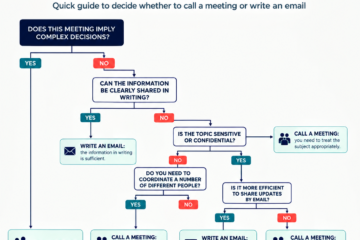
The first question before scheduling a meeting should be:
Do we really need a meeting?
2. Every meeting needs a purpose.
Inform. Decide. Create. Solve. Coordinate…
But “because we have the Tuesday meeting” is not a purpose.
3. Fewer people.
More participants don’t necessarily mean better decisions.
Invite the people who genuinely need to be there.
4. Less time.
A 60-minute meeting doesn’t have to last 60 minutes.
Try 50.
Or 25.
And finish when the objective has been achieved.
5. Agenda before calendar.
First, decide why you need to meet.
Then find a slot in the calendar.
Not the other way around.
6. Preparation before conversation.
If we need data, documents or prior decisions, have them ready beforehand.
A meeting shouldn’t be the place where everyone discovers the problem for the first time.
7. Not everything needs to be synchronous.
An email.
A document.
A video.
A message.
An asynchronous update.
These are also collaboration tools.
8. Protect time to work.
A calendar full of meetings isn’t necessarily a productive calendar.
We need space to think, create, analyse and execute.
Research from MIT Sloan on meeting-free days is particularly interesting in this regard. In a study involving 76 companies, reducing meetings had positive effects on productivity, satisfaction and stress, although the researchers emphasised that the right approach depends on each organisation. (MIT Sloan Management Review)
9. A meeting should end with something.
A decision.
An action.
An owner.
A next step.
If, after an hour, nobody knows what has changed, something probably went wrong.
10. Measure your meetings.
Because what we don’t measure, we can hardly improve.
Number of meetings.
Hours.
Participants.
Cost.
Duration.
Decisions.
Outcomes.
Meeting management needs data too.
And this is just the beginning.
At Meetingitis, we want to research, measure and transform the way we work together.
We want to help companies have fewer meetings and better meetings.
And help professionals recover something that increasingly seems to be in short supply:
Time to work.
That’s why we are building a methodology, tools, research and resources to fight Meetingitis from every angle.
Because it’s not about having an emptier calendar.
It’s about having more time to do what really matters.
Want to get started?
Start with something very simple:
Look at your calendar from last week.
How many meetings did you have?
How many were genuinely necessary?
How many ended with a decision?
And, most importantly…
How many meetings in your calendar next week could simply not exist?
#Meetingitis #Meetings #Productivity #Leadership #Management #FutureOfWork
Sources & Further Reading
The ideas behind the Meetingitis approach are supported by research on meeting effectiveness, meeting overload and the impact of reducing unnecessary meetings.
MIT Sloan Management Review — The Surprising Impact of Meeting-Free Days
Research involving 76 companies with more than 1,000 employees operating across more than 50 countries. The study examined the impact of introducing one to five meeting-free days per week on productivity, communication, engagement, satisfaction, stress and autonomy.
Read the full MIT Sloan Management Review study
Harvard Business Review — Stop the Meeting Madness
An analysis of meeting overload and its impact on executives and organisations, including research showing how meeting time has increased dramatically over the decades.
Read the Harvard Business Review article
Microsoft Work Trend Index — Will AI Fix Work?
Microsoft research examining how employees spend their working time and the impact of meetings, email, chat and interruptions on productivity and focus.
Read the Microsoft Work Trend Index
Microsoft — The New Future of Work Report
Research examining meeting-free days and their relationship with autonomy, communication, engagement, productivity and stress. (Storyblok)
Read the Microsoft report
Meetingitis
At Meetingitis, we believe that meetings should be treated like any other organisational resource:
They should have a purpose.
They should create value.
And they should be measured.
The goal isn’t to eliminate meetings.
It’s to make every meeting worth the time it costs.
👉 Calculate the real cost of your meetings with the Meeting Calculator.


0 Comments