Meeting. Réunion. Reunión. Riunione. Besprechung. Vergadering. Reunião. 会議. 会议.
Change the language, the country or the company, and the word may change.
But the idea is almost always the same: two or more people come together to achieve something that, in principle, requires interaction between them.
And here is the first key:
A meeting should not exist because it is on the calendar. It should exist because there is something that needs to be done together.
What is a meeting?
A business meeting is an organized interaction between two or more people with a specific purpose: to share information, discuss a problem, generate ideas, coordinate actions, make a decision or reach an agreement.
It can be in person, virtual or hybrid. It can last five minutes or several hours. It can involve two people or hundreds.
But one characteristic should always remain:
there is a purpose.
When the purpose disappears, the meeting may still appear on everyone’s calendar… but it no longer has a clear reason to exist.
McKinsey proposes a particularly useful way of looking at meetings: they can be primarily designed to make decisions, solve problems and coordinate, or share information. Being clear about the purpose is one of the foundations of an effective meeting. (mckinsey.com)
The 10 most common types of meetings in companies
Not all meetings are the same. And trying to manage them all in the same way is one of the most common mistakes organizations make.
1. Information-sharing meeting
Purpose: to inform.
Present results, communicate changes, explain a new strategy or share relevant information.
Examples:
- Results meeting
- Town hall
- New initiative presentation
- Internal communication
Key question: do we really need a meeting to communicate this information?
If communication is mostly one-way, an email, video or document may be enough.
2. Status or follow-up meeting
Purpose: to check progress.
What has been done? What is still pending? What problems have appeared? What happens next?
Examples:
- Weekly meeting
- Status meeting
- Project follow-up
- Steering committee
These meetings are extremely common… and can easily become automatic.
“We meet because we always meet” is not a purpose.
3. Decision-making meeting
Purpose: to make a decision.
The meeting should end with a decision, even if there is no complete agreement.
It could involve:
- Approving a project
- Choosing a supplier
- Launching a product
- Approving an investment
- Resolving a strategic issue
McKinsey highlights the importance of clarifying who decides, who advises and who is responsible for execution. (mckinsey.com)
If nobody has the authority to decide, you probably don’t have a decision-making meeting.
4. Problem-solving meeting
Purpose: to find a solution.
There is a specific problem, and the right people come together to analyze it and explore alternatives.
This is not about presenting information.
It is about working on the problem.
The clearer the problem is defined, the easier it becomes to identify who actually needs to be in the room.
5. Coordination meeting
Purpose: to coordinate people, teams or departments.
These are common in projects, operations and complex organizations.
For example:
Marketing needs to know what Product is doing.
Product needs to know what Technology is doing.
Technology needs to know Operations’ deadlines.
The meeting connects interdependent pieces of work.
6. Creative or brainstorming meeting
Purpose: to generate ideas.
Design a product, find new concepts, solve a challenge, create a campaign or explore alternatives.
The objective is not necessarily to make a decision.
First, you need to create possibilities.
Then you evaluate them.
Confusing brainstorming with decision-making can kill good ideas too early.
7. Project meeting
Purpose: to manage a project.
It can combine information-sharing, coordination, problem-solving and decision-making.
That’s why “project meeting” describes the context, but not necessarily the purpose.
A good project meeting should answer one question before it starts:
What do we need to achieve today?
Not simply:
“What’s on the agenda?”
8. One-to-one meeting
Purpose: to work on the relationship between two people.
Between a manager and employee, mentor and mentee, colleagues or project leaders.
It can be used for:
- Feedback
- Development
- Priorities
- Problems
- Career conversations
- Alignment
A 1:1 should not simply become another task-status meeting.
Its value lies in the conversation.
9. Strategic meeting
Purpose: to discuss or decide the future.
Company strategy, priorities, markets, growth, investments, transformation or new business.
These meetings can involve high-impact decisions.
And precisely because of that, they require more preparation, not more participants.
10. Social or connection meeting
Purpose: to connect.
Not every meeting needs to produce a decision.
A team lunch, onboarding session, celebration or informal gathering can have a perfectly valid objective:
building connection.
The problem is not that a meeting is social.
The problem arises when a social meeting pretends to be a work meeting — or when a work meeting becomes a permanent substitute for informal conversation.
One meeting can be several things
This is one of the most common traps.
A meeting can start as:
“Monthly project review”
and become:
Information → discussion → problem-solving → decision → task assignment.
That is not necessarily bad.
But when we try to do five different things at once, the meeting loses focus.
That’s why it is useful to identify its primary purpose.
McKinsey recommends distinguishing especially between meetings designed to share information, discuss/solve problems and make decisions. (mckinsey.com)
The 3 basic rules of a good meeting
You don’t need a 50-page meeting manual.
Start with these three rules.
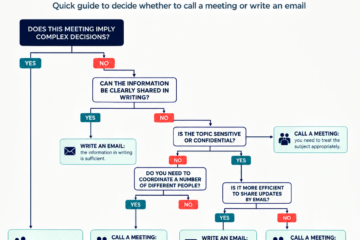
1. Before scheduling: ask whether you need a meeting
Do we really need to meet?
If the answer is no, use another channel.
Email. Document. Chat. Video. Dashboard. Async comment.
The best meeting may simply be the one you never scheduled.
2. Before starting: define what needs to happen
Don’t confuse a topic with an objective.
“Quarterly results” is a topic.
“Decide whether we continue investing in X” is an objective.
A good meeting should be able to complete this sentence:
“By the end of this meeting, we will have…”
If you cannot complete it, you probably haven’t defined the purpose clearly enough yet.
3. Before inviting: decide who actually needs to be there
Not everyone who needs to know about a decision needs to participate in making it.
Ask:
Who decides?
Who provides input?
Who needs to execute?
Who simply needs to be informed?
McKinsey uses this distinction between roles to improve decision clarity and speed. (mckinsey.com)
More participants does not necessarily mean more collaboration.
Sometimes it simply means more time.
What do different parts of the world call a meeting?
“Meeting” is one of those words that appears in almost every language, with different forms and nuances.
| Language | Common term |
| 🇪🇸 Spanish | Reunión |
| 🇬🇧 English | Meeting |
| 🇫🇷 French | Réunion |
| 🇮🇹 Italian | Riunione |
| 🇵🇹 Portuguese | Reunião |
| 🇩🇪 German | Besprechung / Sitzung |
| 🇳🇱 Dutch | Vergadering / bijeenkomst |
| 🇸🇪 Swedish | Möte |
| 🇩🇰 Danish | Møde |
| 🇳🇴 Norwegian | Møte |
| 🇫🇮 Finnish | Kokous |
| 🇵🇱 Polish | Spotkanie |
| 🇷🇺 Russian | Встреча (Vstrecha) |
| 🇹🇷 Turkish | Toplantı |
| 🇬🇷 Greek | Συνάντηση (Synántisi) |
| 🇦🇪 Arabic | اجتماع (Ijtimāʿ) |
| 🇮🇱 Hebrew | פגישה (Pgisha) |
| 🇮🇳 Hindi | बैठक (Baithak) |
| 🇨🇳 Chinese | 会议 (Huìyì) |
| 🇯🇵 Japanese | 会議 (Kaigi) |
| 🇰🇷 Korean | 회의 (Hoeui) |
And in the international business world, there is one word that barely needs translation:
Meeting.
Team meeting. Management meeting. Board meeting. Sales meeting. Project meeting. Kick-off meeting. Status meeting.
The meeting may change language.
The problem of a poorly designed meeting does not.
So, what is a good meeting?
It is not necessarily a short meeting.
It is not necessarily in person.
It is not necessarily 30 minutes.
It is not necessarily small.
A good meeting is one where the time, people and format are justified by the outcome it is intended to achieve.
Because a meeting should not be measured only by:
“Did it last 60 minutes?”
But by:
“What did we achieve because of those 60 minutes?”
And perhaps that is the most important question to start fighting Meetingitis.
Before your next meeting, try something very simple:
Why do we need to meet?
What do we want to achieve?
Who needs to be there?
If you have clear answers to all three, you are already starting to have a better meeting.
0 Comments