Not every problem needs a meeting. And not every email needs to become one.
We have spent years joking about meetings that “should have been an email”.
But the real problem is bigger.
The question is not simply:
“Email or meeting?”
The better question is:
“What is the best way to achieve the outcome we need?”
Sometimes it is an email.
Sometimes it is a message.
Sometimes it is a shared document.
Sometimes it is a quick call.
And sometimes, yes, it absolutely needs a meeting.
The problem starts when meetings become the default answer to every form of collaboration.
The meeting overload problem
The data is difficult to ignore.
Microsoft found that the number of Teams meetings and calls per week had increased by 192% since February 2020. Inefficient meetings were identified as the #1 productivity disruptor, while having too many meetings ranked #3. (Microsoft)
Harvard Business Review has also highlighted research showing that around 70% of meetings can prevent employees from getting productive work done. (hbr.org)
And Atlassian’s research among 5,000 knowledge workers found something particularly revealing:
77% frequently attend meetings that end with the decision to schedule another meeting.
Even more concerning, 54% frequently leave meetings without a clear understanding of the next steps or who owns them. (Atlassian)
So perhaps the issue isn’t that we have “bad meetings”.
Perhaps we have a meeting design problem.
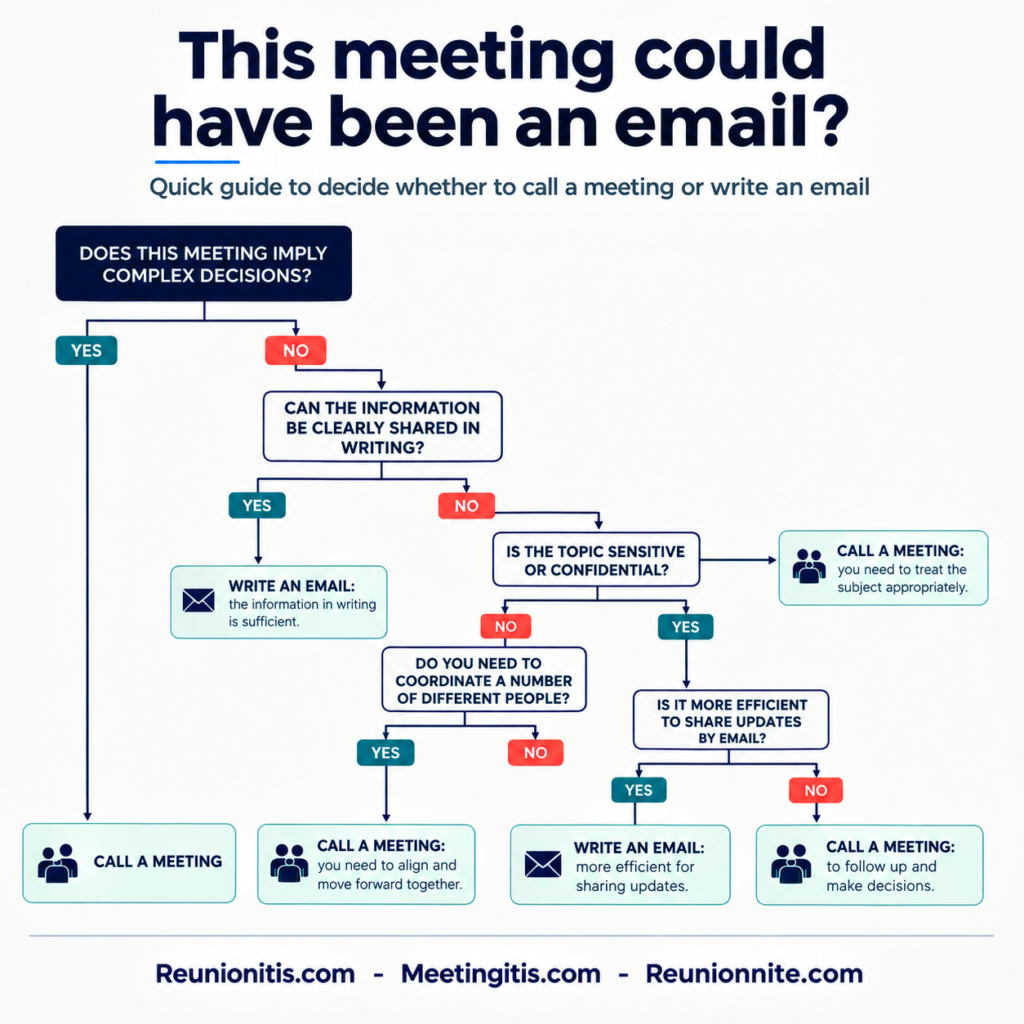
Before scheduling a meeting, ask one question
What are we trying to achieve?
If the objective is simply to:
📩 Share information → try email or async communication.
📄 Review information → use a document or dashboard.
💬 Ask a simple question → send a message.
🧠 Discuss a complex problem → consider a meeting.
⚖️ Make a decision requiring multiple perspectives → a meeting may be appropriate.
🤝 Build relationships, resolve conflict or create alignment → meeting.
🚀 Turn a decision into coordinated action → sometimes a meeting is exactly what you need.
The objective should determine the format — not the other way around.
From “meeting culture” to “meeting intelligence”
This is where I believe organisations need to move next.
We shouldn’t simply ask:
“How can we have better meetings?”
We should ask:
“Do we need this meeting at all?”
And then:
“If we do, what is the minimum meeting required to achieve the outcome?”
That means measuring meeting volume, duration, participants, purpose, preparation, decision-making, outcomes and follow-up.
Because what gets measured can be redesigned.
And what can be redesigned can be improved.
The goal isn’t a meeting-free workplace.
It is a workplace where every meeting has a reason to exist.
- Less meeting overload.
- More focus time.
- Better decision-making.
- Clearer accountability.
And ultimately, more time for the work that actually matters.
Maybe the meeting should have been an email.
But maybe the email should never have existed either.
The real question is:
What is the best way to move the work forward?


0 Comments